WordPress troubleshooting and maintenance
Use this lane for plugin conflicts, failed updates, staging checks, maintenance planning, and practical break-fix guidance for business sites that need safer day-to-day operation.
Use the GEENXT blog as a guided entry point to WordPress support, website performance, security, and eCommerce articles for business websites.
Use this archive as the fastest route into GEENXT's WordPress support content for business websites. The goal is not to show a flat list of posts. It is to help business owners, operators, and in-house teams find the right troubleshooting, performance, security, or eCommerce guidance first, then move into direct support when the issue needs implementation help.
Use this lane for plugin conflicts, failed updates, staging checks, maintenance planning, and practical break-fix guidance for business sites that need safer day-to-day operation.
Use this lane for slow page loads, caching decisions, waterfall analysis, hosting limits, response-time problems, and performance bottlenecks that affect business websites.
Use this lane for WordPress hardening, incident response, security checklists, and implementation decisions where uptime, recovery, and trust matter more than generic advice.
Use this lane for WooCommerce performance, product schema, platform tradeoffs, and store implementation decisions that affect catalog quality, checkout reliability, and discoverability.
GEENXT is a Philippines-based remote website support provider serving global clients. This archive stays focused on business-website problems that connect directly to WordPress troubleshooting, performance work, security, and eCommerce implementation, so readers can move from research into a clearer next action.
GEENXT also publishes selected articles in remote work and freelancing and web development and programming career, but the main archive remains anchored to business website support so the site's core expertise stays clear.
Checking your PHP version, backing up, and updating through your host control panel before verifying the WordPress site still works. How to update PHP in WordPress safely: check your current version under Tools, Site Health, back up your whole site, confirm plugins and theme support the newer PHP version, then switch it in your hosting […]
A stuck .maintenance file is the most common reason a WordPress site won’t leave maintenance mode on its own. If your WordPress site is stuck in maintenance mode, WordPress core is looking for a file called .maintenance in your site’s root folder. Back up your site first, then delete that file using FTP, your host’s […]
Two different WordPress error messages, one root cause: a blocked request to wp-admin or the REST API. A WordPress json error (“Updating failed. The response is not a valid JSON response.”) and a wordpress 403 error usually share the same root cause: something is blocking a request to wp-admin or the REST API (wp-json). Flush […]
Installing an SSL certificate and forcing HTTPS on a WordPress site. WordPress SSL means your site serves every page over HTTPS with a valid certificate installed. Most hosts issue a free certificate automatically; if a page still shows “Not Secure” or a mixed content warning, the fix is usually the WordPress Address (URL) and Site […]
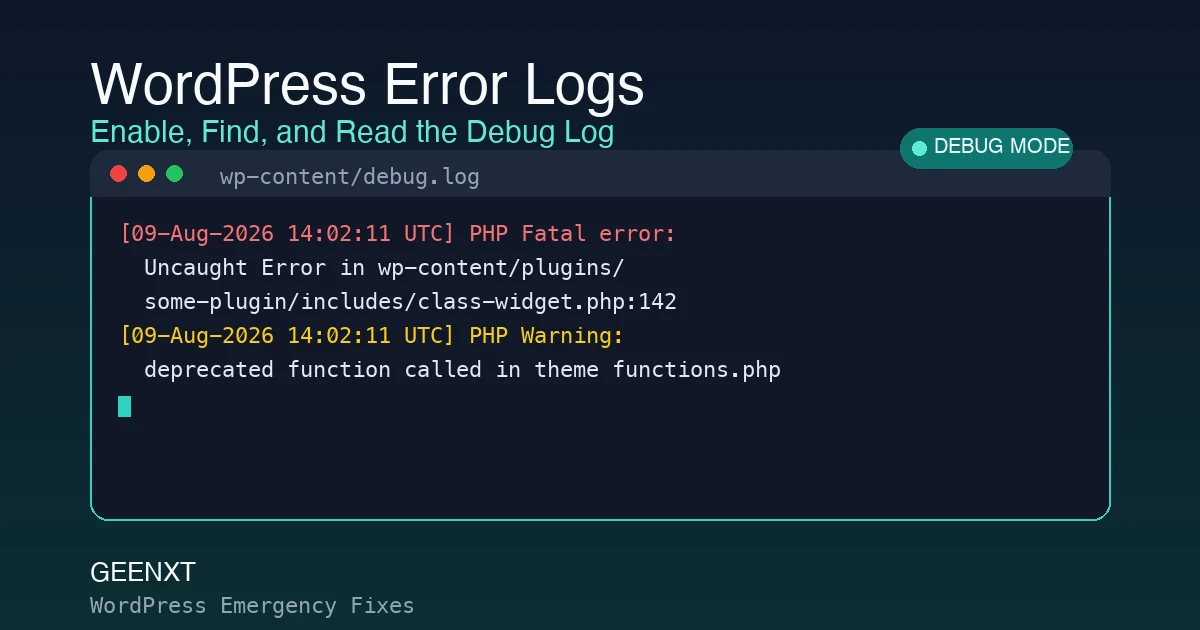
Enabling WordPress debug logging surfaces the exact plugin, file, and line behind a fatal error. A WordPress error log records PHP fatal errors, warnings, and notices as they happen, usually saved to wp-content/debug.log. It stays off by default. Turning it on takes one change to wp-config.php (the WP_DEBUG_LOG constant) or a debugging plugin, and the […]
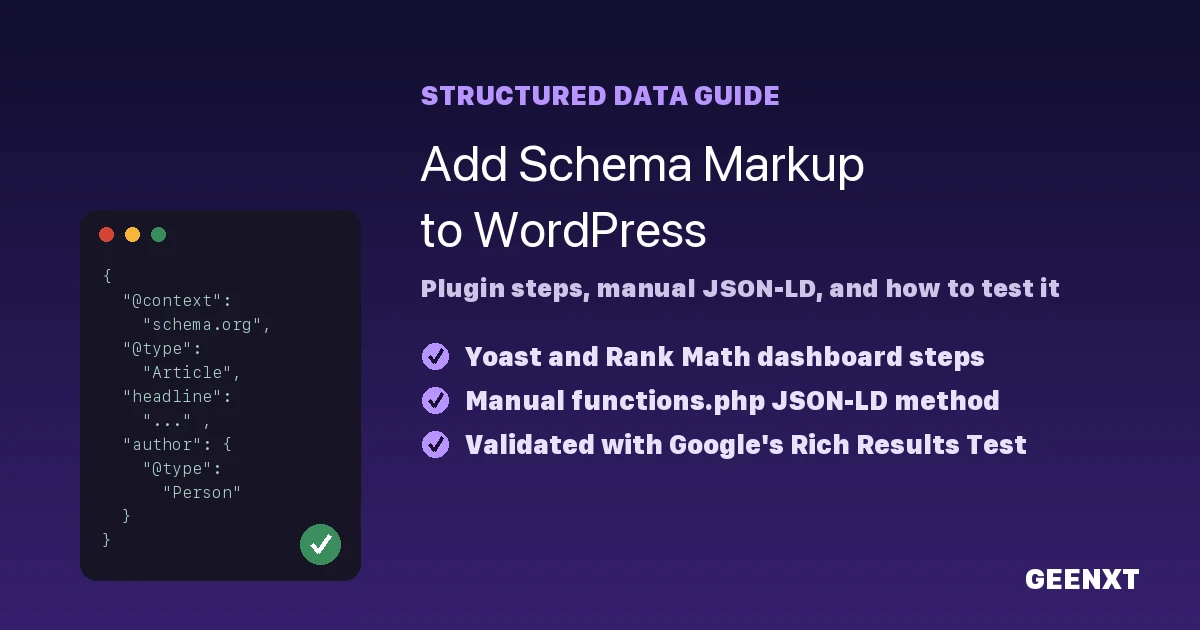
Adding schema markup to a WordPress site through a plugin dashboard and a manual JSON-LD snippet. You add schema markup to WordPress in three ways: through an SEO plugin like Yoast or Rank Math, by pasting JSON-LD code into your child theme’s functions.php file, or through a theme template file. Schema markup is structured data […]