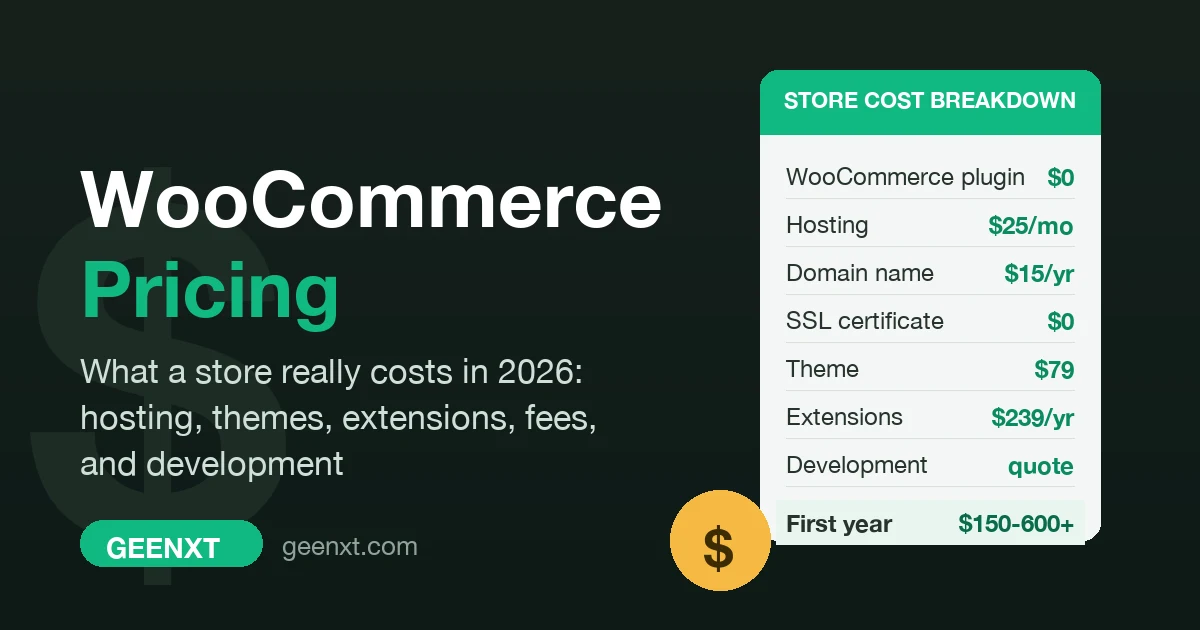
WooCommerce is free to install, but a working store never is. Run it yourself on a lean stack and budget $150 to $600 a year for hosting, a domain, and a couple of paid extensions. Hire someone to build it properly and development adds roughly $1,500 to $30,000 upfront, depending on how custom the store needs to be.
Here is the version of WooCommerce pricing that vendor landing pages tend to blur. The core plugin costs nothing, and it now runs 48.4% of every website with an identifiable ecommerce system, according to W3Techs usage data (2026). What you actually pay for is everything wrapped around the plugin: hosting ($3 to $100+ a month), a domain ($20 a year, give or take), an SSL certificate (free, in almost every case), an optional premium theme ($59 to $129), paid extensions ($79 to $299 a year each), payment processing (about 2.9% plus $0.30 per transaction), and development if you bring in help. We price every one of those lines below, then total three realistic store budgets, from small DIY shops to large custom builds, so you can plan your own with real numbers instead of a vendor’s best-case estimate.
What Does “WooCommerce Is Free” Actually Mean?
WooCommerce lets any WordPress site sell products, and it costs nothing to add. Download it from the plugin repository, install it from your dashboard, and process your first order without paying WooCommerce a cent. The core plugin on wordpress.org is open source, actively maintained, and fully functional out of the box: checkout, products, orders, taxes, and basic reporting all ship free.
So why does the “how much does WooCommerce cost” question keep coming up? Because free software still needs somewhere to live. Hosting and a domain name are bills from a different company than the one that wrote the plugin, and most stores add a handful of paid extras before they look and behave like a real business. Add those pieces together and you get the true cost of a WooCommerce store, and that total swings hard depending on how much of the work you do yourself.
WooCommerce Pricing Breakdown: Every Cost Line by Line
Ten cost lines make up nearly every WooCommerce budget I have priced out for a client. Some of these can legitimately land at $0. Treat the table below as a checklist to run through before launch, not a bill you are guaranteed to pay in full.
| Cost component | Typical range (2026) | Required? |
|---|---|---|
| Domain name | $10-20 per year | Yes |
| Hosting | $3-100+ per month | Yes |
| SSL certificate | $0 (Let’s Encrypt) to $200 per year | Yes (free is fine) |
| Theme | $0 (Storefront) to $129 | Yes (free is fine) |
| Plugins and extensions | $0-900+ per year | Optional |
| Payment processing | ~2.9% + $0.30 per transaction | Yes (per sale) |
| Shipping (WooCommerce Shipping, carrier extensions) | $0-99 per year | Optional |
| Email marketing | $0-50 per month | Optional |
| Design and development | $0 (DIY) to $30,000+ | Optional |
| Maintenance and support | $0 (DIY) to $600 per month | Optional |
The rest of this guide breaks down each line: what pushes it up, what keeps it down, and where store owners routinely overpay without noticing.
WooCommerce Hosting Pricing
Hosting is the one line you cannot skip, and it is where budgets diverge the most. Shared hosting starts at $3 to $15 a month and runs a small catalog just fine, right up until it is the first thing your store outgrows once orders and traffic climb. Managed WooCommerce hosting, tuned for cart and checkout performance specifically, typically runs $25 to $60 a month. Cloud or VPS hosting ranges from $30 to several hundred a month once a catalog gets large enough to need dedicated resources.
Two traps show up in almost every hosting quote I review. First, renewal pricing: a $2.99 introductory rate often resets to $10 to $15 a month at renewal, which is $120 or more a year, so plan around the renewal number, not the promo. Second, bundled extras: a free domain in year one, or daily backups thrown in, sound generous until you check what they cost once the promo period ends. A host that buries its renewal table in fine print is telling you something.
Domain, SSL, and the Other Basics
A domain name runs $10 to $20 a year at any mainstream registrar (niche TLDs cost more), and it is often discounted or free for the first year when bundled with hosting. An SSL certificate should cost you nothing: Let’s Encrypt issues free certificates, and every reputable host installs one automatically. Paid certificates ($50 to $200 a year) only make sense for specific corporate validation needs, not for a typical store. If a host tries to charge you for basic SSL, treat that as a red flag and shop elsewhere.
WooCommerce Theme Pricing
A free theme is a legitimate place to start, not a compromise. Storefront, the official free theme, comes from the same team that builds the plugin and is designed around WooCommerce specifically. Popular WordPress themes built for WooCommerce, Astra, Blocksy, Kadence among them, also ship with capable free tiers.
A premium theme runs $59 to $129, either as a one-time purchase or an annual fee for updates. What that buys you is nicer product page layouts, more cart customization, and priority support when something breaks. My rule of thumb: launch on a free theme, and upgrade only when you hit a specific layout or feature limit, not because a marketplace demo looked polished.
Plugin and Extension Costs
Extensions are where a “free” store quietly turns into a $1,000-a-year store. The plugin itself is free, and thousands of free add-ons cover most of what an early-stage store needs at no cost. But nearly every store that grows past its first year ends up buying at least one or two paid extensions, and official WooCommerce extensions are not cheap: $79 to $299 a year each on the WooCommerce marketplace.
The extensions people actually pay for: WooCommerce Subscriptions for recurring billing at $239 a year, bookings and membership extensions in the $129 to $249 range, and bundled plugins for wholesale or B2B pricing tiers. Third-party tools that plug into WooCommerce, accounting sync, advanced search, email platforms, usually bill separately as their own monthly subscriptions. My rule for clients: list only the features your store needs to take money on day one, buy those extensions at launch, and add the rest once growth justifies them. Every extension is also code you have to keep updated, so a leaner stack saves you twice over.
Payment Processing and Transaction Fees
WooCommerce itself never charges a transaction fee, which is a genuine advantage over hosted platforms. But that does not make selling free, because your payment gateway takes a cut on every sale. WooPayments, Stripe, and PayPal all cluster around 2.9% plus $0.30 per online card transaction in the US, with the exact rate shifting by country and card type, per the official WooPayments fee documentation.
Run $100,000 in annual sales through that math and you land around $3,200 in processing costs, regardless of which platform you sell on. The practical takeaway: WooCommerce does not charge you a platform commission, but processing fees are a permanent slice of revenue, so build them into your margins from day one instead of treating them as a one-time setup line.
How Much Does WooCommerce Website Development Cost?
This is the line most hosting-company guides skip, because they do not actually build stores. We do, so here are honest 2026 tiers for what design and development costs:
| Build type | Typical cost | What you get |
|---|---|---|
| DIY build | $0 (your time) | Free theme, standard checkout, your evenings |
| Template build | $1,500-5,000 | Professional setup of a premium theme, catalog, payments, shipping |
| Custom build | $5,000-30,000 | Custom design, bespoke features, integrations, performance work |
| Enterprise build | $30,000+ | ERP integrations, multi-currency, custom apps, dedicated team |
Do you need a developer at all? No. Plenty of owners build a working WooCommerce store themselves, and it is a realistic path for a small catalog. Bring in professional help when the build needs custom functionality, when checkout speed is directly tied to revenue, or when your own time is worth more than the build would cost. What drives the price of hiring a WooCommerce development agency is scope and customization, not the plugin itself: every custom feature, every integration, every design round adds hours. Our WooCommerce development services page walks through what each engagement includes; get a fixed quote on scope before anyone touches code, and be wary of any agency that quotes a custom build without first asking about your catalog and integrations.
Real WooCommerce Cost Scenarios: Small, Mid-Sized, and Large Stores
Line-item prices only mean something once you add them up. Here are three budgets I see most often in practice. Your own numbers may land above or below these, but most businesses fall inside one of these three brackets.
| Scenario | First-year cost | Ongoing cost per year |
|---|---|---|
| Small DIY store (free theme, shared hosting, 0-1 paid extensions) | $150-600 | $150-500 |
| Mid-sized store (template build, managed WooCommerce hosting, 2-4 extensions) | $3,000-8,000 | $800-2,500 |
| Large store (custom build, cloud hosting, extension stack, retainer support) | $12,000-40,000 | $3,000-10,000+ |
Add payment processing at roughly 2.9% + $0.30 on every sale across all three scenarios. Starting at the small end and upgrading pieces as revenue justifies them is a completely normal path with WooCommerce, unlike SaaS platforms that push you onto a bigger plan whether you need it or not. That flexibility, small stores paying almost nothing while large stores pay for exactly what they use, is the strongest case for the WooCommerce model as a whole.
How to Reduce Your WooCommerce Costs
- Start on a free theme. Storefront or a free tier of a major theme handles most launches; upgrade only when you hit a specific need.
- Buy extensions one at a time. They run $79 to $299 a year each; review your list annually and drop anything the store can run without.
- Budget on the renewal price. Hosting and domain promos reset after year one; check the year-two number before you commit.
- Right-size your hosting. A 20-product store does not need a $60-a-month plan, and a 2,000-order-a-month store cannot run on $5 shared hosting.
- Use free tiers while you can. Email marketing, analytics, and search tools all have workable free tiers below real volume.
- Scope development tightly. A fixed-scope template build now, plus targeted custom work later, almost always beats a speculative custom build up front.
WooCommerce vs Shopify Pricing, Briefly
Short version: Shopify charges a predictable monthly fee ($39 to $399) plus transaction fees unless you use its own payment gateway, while WooCommerce skips the platform fee and puts hosting, extensions, and maintenance on you instead. Cheap and self-managed favors WooCommerce; hands-off and bundled favors the SaaS model. We cover the full trade-off in our WooCommerce vs Shopify comparison, so we will not repeat it here.
What About Ongoing Maintenance?
Every store needs WordPress core, plugin, and theme updates, plus backups, security monitoring, and the occasional fix. DIY maintenance costs nothing but real time; professional care plans run roughly $50 to $600 a month depending on response times and scope. That is a separate line from the build itself, and we priced it out in detail in our WordPress maintenance retainer pricing guide. If this guide answers what your store costs to build and run, that one answers what it costs to keep healthy afterward.
Frequently Asked Questions About WooCommerce Store Costs
Is WooCommerce free to use, or are there mandatory fees?
The plugin itself is genuinely free, with no mandatory platform fees. What you cannot avoid is hosting ($3 to $100+ a month), a domain name ($10 to $20 a year), and payment processing on every sale. Everything else, themes, extensions, development, is optional.
How much does WooCommerce cost per year?
A small self-managed store typically runs $150 to $500 a year. A mid-sized store with managed hosting and a few paid extensions lands around $800 to $2,500 a year. Large stores with custom features and professional support commonly spend $3,000 to $10,000 or more a year, before payment processing.
Do I have to pay transaction fees with WooCommerce?
WooCommerce itself charges nothing on transactions. Your payment gateway does: WooPayments, Stripe, and PayPal each take roughly 2.9% plus $0.30 per online card transaction in the US. Those fees apply on any platform you sell through, so they are a cost of selling online, not a WooCommerce fee.
How much does WooCommerce website development cost?
Professional development runs about $1,500 to $5,000 for a template-based build, $5,000 to $30,000 for a custom store with bespoke design and integrations, and $30,000 or more for enterprise projects. DIY costs nothing but your time, which is the right call for plenty of small catalogs.
Is WooCommerce cheaper than Shopify?
Usually, at the low end: a lean WooCommerce store can run under $200 a year, while the hosted alternative starts at $39 a month plus app costs. The gap narrows at larger scale, since WooCommerce hosting, extensions, and maintenance all grow with the store. The honest answer comes down to how much of the management you want to own yourself.
Do I need to be a developer to use WooCommerce?
No. Installing WooCommerce, adding products, and taking payments are all point-and-click from the WordPress dashboard. You would want a developer for custom checkout behavior, integrations with other business systems, or performance work on a large catalog, which is exactly where budgets shift from software to services.
What are the hidden costs of running a WooCommerce store?
The four that catch owners off guard: renewal pricing on hosting and domains once the promo year ends, extension subscriptions that quietly stack up ($79 to $299 a year each), payment processing as a permanent percentage of revenue, and the time maintenance takes. None of them are hidden by WooCommerce itself; they hide in vendor fine print.
How can I reduce WooCommerce costs as my store grows?
Audit your extensions every year and cancel what is unused, move hosting tiers only when performance data actually calls for it, stay on free tiers of email and analytics tools until volume forces an upgrade, and buy fixed-scope development instead of open-ended retainers until revenue supports ongoing work.
Plan Your WooCommerce Budget with Real Numbers
The best WooCommerce budget is a boring one: a realistic hosting line, one or two extensions the store genuinely needs, free SSL, and development scoped to features that actually move revenue. If you are budgeting a build and want a line-item quote instead of a range, our WooCommerce development team will price your exact catalog, integrations, and design scope. If you are comparing ongoing care costs, start with the retainer pricing guide. Either way, you now have the full cost picture that most vendor pages never put in one place.
For more free guides like this one, see GEENXT’s Resources Hub.