
A WooCommerce development agency designs, builds, and maintains online stores on WordPress and WooCommerce. Unlike a general web development company, it specializes in ecommerce: product architecture, checkout flows, payment integrations, and store performance. Businesses hire one to launch a new store, rebuild an underperforming site, or migrate an existing online store from platforms like Shopify or Magento to WooCommerce.
WooCommerce is an open-source ecommerce plugin for WordPress, and according to W3Techs usage data, it powers 48.4% of all websites that run a known ecommerce system, more than any other platform. That popularity is exactly why the quality gap between agencies is so wide: anyone can install the plugin and call the result an online store, but few teams can architect one that stays fast at 10,000 products and converts paid traffic profitably. GEENXT is a WooCommerce development agency that handles store builds end to end: custom theme development, plugin development, migration from other platforms to WooCommerce, and the WooCommerce SEO services that make a store visible after launch. This guide explains what a WooCommerce agency actually does, what store development costs, and how to vet a development partner before you sign, whether that ends up being us or someone else.
What Does a WooCommerce Development Agency Do?
A WooCommerce development company provides the full stack of ecommerce work that turns WordPress and WooCommerce into a revenue channel. The core services fall into seven buckets:
- Custom store builds. End-to-end WooCommerce development: information architecture, product taxonomy, cart and checkout design, and payment gateway setup. This is store development from a blank canvas, not a template dropped onto hosting.
- WooCommerce website design and theme development. Custom theme development or a heavily tailored block theme, built around your catalog and brand. Good WooCommerce web design is conversion work first and visual work second: the design and development decisions that shorten the path from product page to payment.
- Custom WooCommerce plugins. Custom plugin development for business logic that off-the-shelf WooCommerce plugins cannot handle: bespoke shipping rules, quoting engines, subscription variants, or ERP connectors.
- Migration services. WooCommerce migration services move stores from Shopify, Magento, BigCommerce, or an aging custom build. Moving your current platform to WooCommerce means migrating products, customers, order history, and URL structure without losing rankings.
- API and integration work. WooCommerce API development connects the store to fulfillment, accounting, CRM, and marketing automation. Headless setups and PWA development sit in this bucket too, though most mid-market stores do not need them yet.
- WooCommerce B2B stores. Wholesale pricing tiers, account-based catalogs, quote workflows, and customer portals. B2B is where businesses using WooCommerce beat hosted platforms on flexibility, and where expert WooCommerce development matters most.
- Performance and maintenance. Speed optimization, security hardening, and ongoing support after launch, because a store is software that needs an owner.
Some web development agencies also bundle digital marketing services. As an ecommerce development company, we keep the scope tighter: development, performance, and SEO, done deeply, rather than a comprehensive range of services done thin. Our generic plugin and theme work lives on our WooCommerce development services page; this article is about full store builds.
Agency vs Freelancer vs DIY: Who Should Build Your WooCommerce Store?
You have three ways to get a WooCommerce website built, and the honest answer is that each one fits a different business stage.
| Factor | DIY (builder or template) | Freelance WooCommerce developer | WooCommerce agency |
|---|---|---|---|
| Typical cost | $0 to $500 | $2,000 to $15,000 | $8,000 to $75,000+ |
| Timeline | Days | 4 to 10 weeks | 6 to 16 weeks |
| Accountability | You | One person (bus factor) | Team with process and QA |
| Post-launch support | None | Ad hoc | Contracted care plans |
| Best for | Testing an idea | Small scoped features | Revenue-critical stores |
If you want to hire WooCommerce developers for a single feature, a vetted freelancer is often the right call. If the store is how your business makes money, a team of WooCommerce specialists with a documented development process protects you from the two failure modes we see most: the abandoned half-build and the store that works but cannot scale. A WooCommerce developer working alone has no one reviewing their code; an agency partner ships through code review, staging, and QA.
How We Approach WooCommerce Store Builds at GEENXT
Every agency claims a process. Here is ours, concretely, because our approach to WooCommerce development is the thing you are actually buying:
- Scope and architecture (week 1 to 2). We audit your catalog, integrations, and traffic data, then produce a fixed scope with a product taxonomy plan. A WooCommerce development project that starts without a written scope ends in change-order purgatory.
- Design and UX (week 2 to 4). Website design and development run in parallel: wireframes for category, product, cart, and checkout pages, tested against the user experience patterns that ecommerce buyers already know. We use native WooCommerce blocks where they fit, custom development where they do not.
- Build (week 4 to 10). Theme, custom WooCommerce plugins, payment and shipping integration, and content entry. Everything ships to a staging site first.
- Performance and QA (week 10 to 12). Load testing against Core Web Vitals thresholds, checkout testing with real payment sandboxes, and accessibility checks. Slow stores lose carts; we treat speed as a launch gate, not a post-launch wish.
- Launch and support (week 12+). DNS cutover, redirect map verification, analytics validation, and a support retainer if you want one. We do not disappear after the invoice clears.
Timelines assume a mid-size catalog. A five-product store moves faster; a 40,000-SKU B2B catalog with ERP sync does not.
WooCommerce SEO Services: Built Into Every Store We Ship
Most WooCommerce development projects fail commercially for a reason that has nothing to do with code: nobody can find the store. That is why we fold WooCommerce SEO services into every build instead of selling search as an afterthought. A store that launches without crawlable category architecture, product schema, and fast templates starts its life invisible.
Concretely, our WooCommerce SEO service covers product and category page architecture that matches how people actually search, structured data for products, reviews, and offers, Core Web Vitals optimization on the templates that carry revenue, and internal linking between categories, products, and content. It is the same discipline behind our WordPress SEO services, applied to ecommerce, where every ranking position maps to revenue rather than page views.
If your store is already live and losing organic ground, that work can be retrofitted. We rebuilt our own site’s search foundations in June 2026 after a technical audit scored it 53 of 100, and the same checklist we used internally is the one we now run on client stores.
Rescue Projects: Taking Over an Existing WooCommerce Store
About a third of the inquiries we get are not new builds. They are existing WooCommerce stores in trouble: a build another agency abandoned, a checkout that breaks after every plugin update, or product pages that take six seconds to load. We take over stores other teams built, and the intake is always the same: full code and database audit, plugin inventory (the record so far is 96 active plugins), and a prioritized fix list before any rebuild talk.
Slow stores are the most common rescue. WooCommerce ecommerce sites accumulate plugin weight fast, and the fix is usually architectural rather than another caching plugin; our guide to speeding up WooCommerce product and category pages shows the exact diagnostic sequence. For stores that are actively down or hacked, our emergency WordPress fixes service exists precisely because ecommerce downtime is measured in lost orders, not inconvenience.
If a previous developer still controls your hosting or admin access, we handle that handover too. It is more common than anyone admits.
How Much Does WooCommerce Development Cost?
The honest answer is a range, and anyone quoting a flat price before seeing your catalog is guessing. WooCommerce development costs scale with catalog complexity, integration count, and how much custom logic your checkout needs.
| Scope tier | Typical range | What it covers |
|---|---|---|
| Starter store build | $8,000 to $20,000 | Tailored theme, standard payments and shipping, up to a few hundred products, launch SEO baseline |
| Custom store build | $20,000 to $50,000 | Custom design and development, 1 to 3 custom plugins, migration from an existing platform, integrations |
| Complex or B2B build | $50,000 to $150,000+ | WooCommerce B2B portals, ERP and fulfillment sync, headless or PWA frontends, multi-currency |
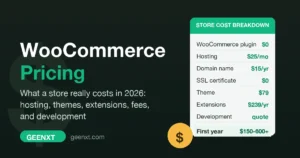
Ongoing costs matter as much as the build: hosting sized for ecommerce (see our WordPress hosting for WooCommerce comparison), premium plugin licenses, and a maintenance plan. We publish a detailed WooCommerce pricing breakdown separately, but as a planning rule, budget 15 to 25 percent of the build cost annually for upkeep. Beware of quotes that look like a deal because they exclude it.
How to Choose the Right WooCommerce Development Agency
The best WooCommerce development agencies look similar on their websites. The differences show up in how they answer questions. Ask these seven before you sign anything:
- Can I see two live WooCommerce stores you built, with the metrics that changed after launch?
- Who exactly will write the code, and is that work in-house or subcontracted?
- How do you handle staging, code review, and deployment? (A leading WooCommerce team answers this in detail without blinking.)
- What happens to my rankings during migration, and who owns the redirect map?
- What does your quote exclude? (This surfaces hidden costs faster than asking what it includes.)
- Do you specialize in WooCommerce, or is it one platform among many?
- What support do you offer after launch, at what response time, and at what price?
Red flags: a quote delivered within hours of your first call, no questions about your product data, portfolio screenshots without URLs, and any promise of a specific Google ranking. Directories like Clutch help you build a shortlist of top WooCommerce development agencies, but treat reviews as a filter, not a verdict; the vetting questions above are what separate the right WooCommerce development partner from a good salesperson. The official WooCommerce developer resources are also worth skimming so you recognize when an agency is describing real platform capabilities versus inventing them.
Frequently Asked Questions
How do I choose the right WooCommerce development agency?
Shortlist teams that specialize in WooCommerce rather than generalist web development agencies, then vet them on live store URLs, code ownership, staging and QA process, migration handling, and post-launch support terms. Ask what their quote excludes. An agency that asks detailed questions about your catalog and integrations before pricing is showing you how it scopes; one that quotes instantly is guessing.
What services do WooCommerce development agencies offer?
The comprehensive services list includes custom store builds, WooCommerce website development and theme work, custom plugin development, migration services to help you move from Shopify or Magento, API and integration development, B2B store features, performance optimization, and ongoing maintenance. Many agencies also offer WooCommerce web design and SEO. Scope varies widely, so confirm which services are in-house versus subcontracted.
How much does it cost to develop a WooCommerce store?
Typical agency-built stores run $8,000 to $20,000 for a starter build, $20,000 to $50,000 for a custom build with migrations and integrations, and $50,000 or more for complex B2B or headless projects. Freelancers cost less for scoped features. Budget another 15 to 25 percent of the build cost per year for hosting, licenses, and maintenance.
Why hire a professional WooCommerce development agency instead of a freelancer?
An agency gives you a team, a documented development process, code review, staging environments, and continuity if one person leaves. A freelancer is cheaper and fine for small scoped work, but a revenue-critical store carries bus-factor risk: one unavailable person can stall your business. Agencies also carry broader WooCommerce skills across design, development, performance, and SEO.
How does WooCommerce compare to Shopify or Magento for a business store?
WooCommerce offers full code ownership, no platform transaction fees, and unlimited customization on WordPress, at the cost of managing your own hosting and updates. Shopify trades control for convenience; Magento suits enterprise catalogs with dev teams. Our WooCommerce vs Shopify comparison covers total cost of ownership over three years, which is where the platforms really diverge.
Can you take over a WooCommerce store another agency or freelancer built?
Yes. Takeover projects start with a code and database audit, a plugin inventory, and an access handover, then a prioritized fix list. Most inherited stores do not need a rebuild; they need their worst decisions reversed in order. If the previous developer is unresponsive or controls your hosting, we manage that recovery process as part of the intake.
Do you provide support after the store launches?
Yes. Every build includes a post-launch stabilization window, and ongoing care plans cover updates on a staging-first workflow, security monitoring, backups, performance checks, and priority fixes. Support is optional but recommended: WooCommerce stores run on software that updates constantly, and an unmaintained checkout eventually becomes a broken one.
Ready to Build a Store That Sells?
Whether you need a new WooCommerce store, a migration, or a rescue of an existing WooCommerce build, the next step is a scoping conversation, not a contract. See our WooCommerce development services, or start with the broader WordPress development agency team behind them. Bring your store’s numbers; we will bring specific answers.
If you’re scoping ongoing support alongside a build like this, GEENXT’s Freelance Web Support SLA Template is a ready-to-use structure for documenting response times and escalation.